
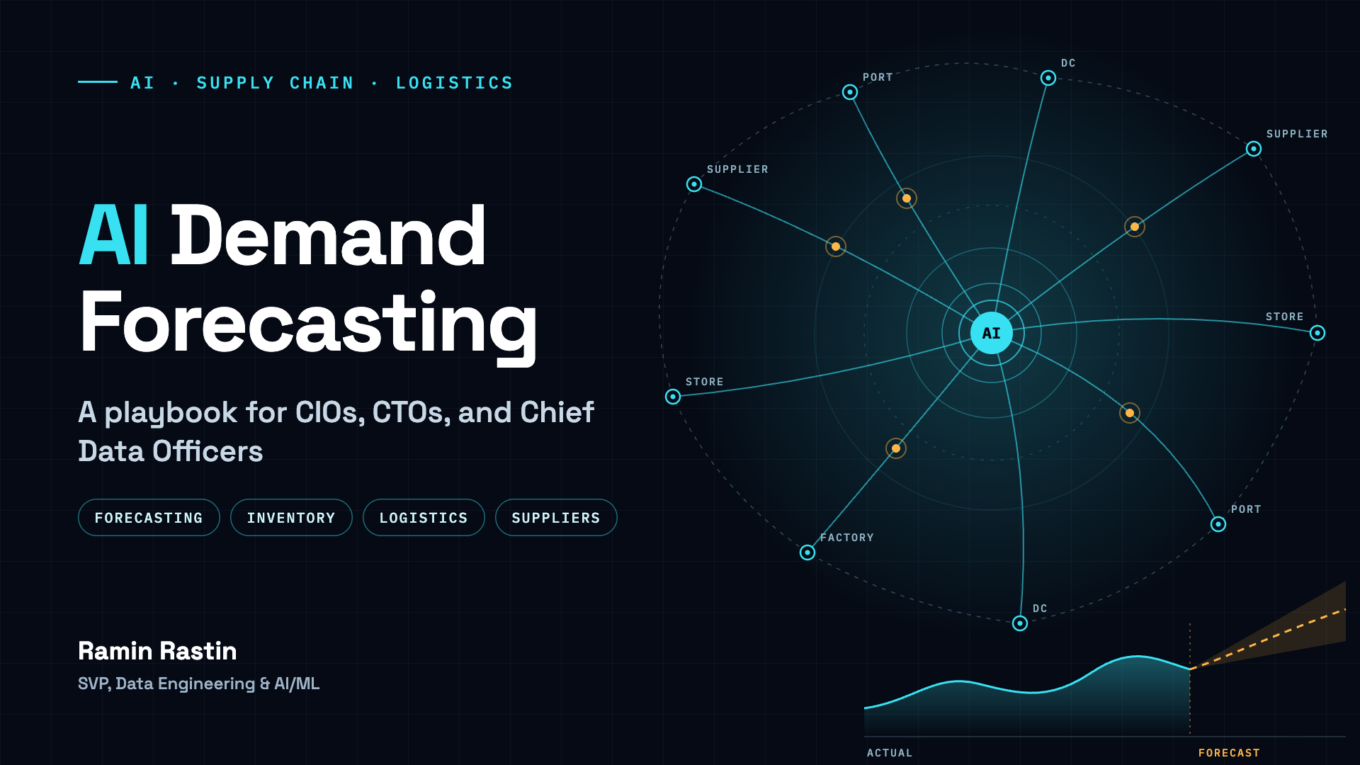
AI Demand Forecasting Is a Business Decision, Not a Data Science Project
Every forecast is wrong. What matters is how wrong, how quickly you find out, and what the miss does to your P&L. I’ve spent 15 years leading enterprise technology, data, and AI organizations at multiple Fortune 500 companies and at scale, and forecasting is where technology and the business collide most often. What I’ve learned is that the model is rarely the hard part. The operating model around it is.
Why forecasting is back on the executive agenda
Traditional forecasting leans on historical sales. That works until the market stops looking like last year: a demand spike, a severe storm, a port delay, a supplier that suddenly can’t ship. AI-driven predictive analytics and demand sensing read what history can’t, including point-of-sale data, weather, promotions, economic indicators, and supplier and logistics performance, refreshed close to real time. McKinsey research puts the reduction in forecast error at 20 to 50 percent. In food and beverage, where shelf life is short, that shows up directly as less waste and healthier margins.
Generative AI dominates board conversations right now. I’d argue some of the most dependable enterprise AI value is still in forecasting and planning, where the payoff can be measured in the P&L.
Start with the data foundation, not the model
In most large enterprises, the inputs to a forecast live in five or six systems that were never designed to work together: ERP, point of sale, warehouse management, supplier portals, external data feeds. A strong model on weak data gives you confident wrong answers. So I start with data engineering, data governance, and enterprise architecture on a cloud platform that can scale from pilot to enterprise-wide production. If legacy systems and technical debt are in the way, cloud modernization has to come first or run alongside the AI work. I’ve watched too many promising pilots stall in the lab because that step was skipped.
Inventory is a working capital decision
Inventory is where the forecast hits the balance sheet. Excess stock ties up capital and drives storage costs. Shortages cost sales and customer loyalty. AI-driven inventory systems monitor sales, market conditions, and supplier performance, then adjust stock levels continuously. For the CFO, that means released working capital and fewer write-offs. For the COO, better availability and service levels. For planners, less time on manual monitoring and more on the exceptions that need judgment.
Logistics: resilience is enterprise risk management
Route optimization gets the attention, and the gains in cost per delivery and on-time performance are real. The bigger prize is anticipation. When AI flags a storm, a geopolitical shift, or a struggling carrier early, you can reroute shipments or move to another supplier before a small issue becomes a customer problem. Call it operational excellence if you like. It’s also risk management, and it belongs in the same conversation as business continuity.
Suppliers: third-party risk is a cybersecurity issue too
AI can analyze historical and live performance data to flag likely delays, quality problems, and financial instability across your supplier base. That gives procurement better facts at the negotiating table and earlier warning on the relationships that matter most. Every supplier connection is also part of your attack surface. Third-party cyber risk deserves the same rigor as delivery risk, and your CISO should be in the room from day one.
What I’d tell any CIO, CTO, or other Chief Data & AI Officer starting this work
- Name a business owner outside technology. An AI strategy that no COO or CFO is willing to be measured on is a science project.
- Fund the foundation. Data quality, governance, and architecture set the ceiling for everything built on top.
- Run it as a product, not a project. Put product engineering, software engineering, data science, and the planners who will use it on one team with one roadmap.
- Govern AI like enterprise risk. Responsible AI, model monitoring, explainability, and human oversight belong in the design, not in a compliance review after launch.
- Be disciplined about build versus buy. Build where it differentiates you. Buy where it doesn’t.
- Invest in change management. Planners who trust the system will use it. Planners who don’t will work around it. Executive sponsorship, training, and talent strategy decide which you get.
For the SVPs and VPs of technology, data engineering, and AI who carry the delivery, numbers one and three are where I’d spend your first 90 days.
The shift that matters
Moving from reactive to proactive operations is the real opportunity, and the technology to do it is available today. But this is what digital transformation looks like in practice. It isn’t a technology rollout. It’s a change in how the business makes decisions. A forecast only creates value when someone changes a decision because of it. The companies that capture the value won’t have the cleverest algorithms. They’ll have trusted data, clear accountability, and leaders willing to be measured on outcomes.
If you lead technology, data, or AI at scale: what has kept your best pilot from reaching production?