How Generative AI Is Transforming ERP Systems in Logistics

Enterprise resource planning (ERP) software delivers measurable improvements for 95% of companies that implement it. As a result, the global ERP market is experiencing rapid growth and is projected to surpass $117.69 billion by 2030.

At its core, an ERP system serves as an organization’s central nervous system. It integrates data and processes across departments to improve visibility, reporting, communication, and control. In logistics, this translates to better insight into supply and demand, real-time shipment tracking, optimized resource allocation, and more accurate forecasting.

The current wave of interest in upgrading logistics ERPs is being driven by generative AI (genAI). These tools allow users to interact with complex data using natural language, enabling faster insights and more intelligent decision-making. According to recent reports, 61% of companies globally have begun integrating genAI into their operations over the past six months, with analytics and resource management among the top priorities.

What Generative AI Adds to Logistics ERPs

GenAI enhances ERP capabilities by allowing logistics teams to query data conversationally. Instead of navigating multiple dashboards or running manual reports, users can simply ask questions in plain language and receive actionable answers.

For example, an ERP can show which trucks are available and their maintenance history. With genAI, a user could type: “Which trucks are available Tuesday at 6 p.m. for a long-haul shipment to Rotterdam carrying X tons of Y-wide crates?”

The system can then return a precise list of suitable vehicles. This level of speed and simplicity is powerful — but it also highlights important limitations.

Hype vs. Reality

While genAI can dramatically improve efficiency, it is not a magic solution. The quality of its output depends entirely on the quality of the data it’s trained on and the clarity of the prompts it receives.

Consider the truck availability example again. If a new employee forgets to include load dimensions or weight requirements, or if the model’s training data is outdated, the recommendations could be inaccurate or unsuitable. External factors — such as sudden spikes in demand or new competitors — can also quickly reduce the tool’s reliability without proper oversight.

In short, genAI tools are only as good as the data and governance behind them. They require ongoing human supervision, training, and validation to remain effective.

Implementation Challenges in Logistics

Successfully integrating genAI into an existing ERP system requires careful planning. Common obstacles include data integration issues, compatibility with legacy systems, and the need for specialized expertise.

One area where genAI shows strong potential in logistics is customs documentation. Here are three practical ways companies are using it to improve efficiency:

1. Automated Data Extraction GenAI can pull relevant information from invoices, packing lists, and customs declarations, significantly reducing manual work. This can save logistics teams three to five days per shipment. However, because customs rules vary widely by country, the AI must be properly trained on specific regulations, tariff classifications, import duties, and trade agreements to avoid errors.

2. Compliance Checks Using natural language processing, genAI can review documentation against current regulations and historical data to flag potential compliance issues before submission. This helps reduce delays, penalties, and the risk of goods being held at customs.

3. Document Generation Once data is extracted, genAI can automatically generate standard customs documents such as invoices, bills of lading, and declarations. This reduces repetitive work while helping ensure consistency and compliance with required fields (origin, destination, quantities, descriptions, etc.).

The Human Factor: Managing Expectations

According to Gartner’s 2025 report on GenAI for Supply Chain, the biggest barriers logistics leaders face are unrealistic expectations (58%), rushing implementation (38%), and unclear objectives (37%).

To avoid these pitfalls, companies should establish clear goals for genAI adoption and align them with existing business processes. Many successful organizations are addressing this by creating a cross-functional Center of Excellence (CoE). These teams bring together diverse expertise to oversee implementation, conduct risk assessments, and ensure the technology supports — rather than disrupts — operations.

A CoE should also focus on continuous monitoring and feedback. GenAI models need regular updates and human oversight to stay accurate as business conditions change. While it’s important to start with specific objectives, organizations should remain open to discovering new use cases as they gain experience with the technology.

Key Takeaway

Generative AI is a powerful tool for enhancing ERP systems in logistics, but it is not a plug-and-play solution. Success depends on realistic expectations, strong data governance, and active human involvement.

Logistics companies that set clear goals, establish proper oversight through a Center of Excellence, and treat genAI as a collaborative tool rather than a replacement for expertise will be best positioned to realize its full potential.

What Every CIO Needs to Know About AI Traffic Before It Becomes a Crisis

Something changed on your network over the past year and most IT teams haven’t noticed yet. Every major SaaS tool in your stack — Microsoft 365, Salesforce, your help desk platform, your project management tool — quietly shipped AI features that are now generating inference requests and API calls that didn’t exist 12 months ago. None of it shows up as a line item labeled “AI traffic” on your bandwidth report, but it’s there, and it’s growing with every vendor update you approve.

Gallup’s latest workforce data puts AI usage among U.S. employees at 50%, up from 21% in 2023, and most of that activity runs through existing business applications rather than standalone tools like ChatGPT. That means the traffic is hiding inside SaaS sessions your network has been running for years. Microsoft’s own documentation acknowledges that Copilot alone requires persistent WebSocket connections that will break entirely if your proxy settings or TLS inspection policies aren’t updated. Most teams find out the hard way when someone files a ticket saying Word is behaving strangely.

The scale of the problem is bigger than most people realize. Research cited by Network World found that machines running agentic AI workflows generate roughly 100 times more requests than human users — with zero off-hours. IDC data shows enterprise cloud connectivity bandwidth is expected to grow 49% this year, with four in ten companies already reporting bandwidth spikes exceeding 50%. Meanwhile Broadcom’s 2026 State of Network Operations report found that 95% of IT teams lack visibility into at least one major network delivery segment, and only 49% believe their infrastructure can handle AI workload demands.

The good news is you don’t need an expensive observability platform to start getting visibility. Free tools like ntopng or PRTG’s free tier give you NetFlow analysis that can establish a current baseline. Look for sustained increases in HTTPS traffic to known SaaS endpoints, new WebSocket connections that weren’t there six months ago, and API call patterns that spike outside business hours — that after-hours activity is often your clearest signal that something new is running. From there, revisit your QoS policies so AI-driven API calls aren’t competing with voice and video for the same bandwidth, and check vendor network requirements documentation before enabling new AI features.

The diagnostic steps are familiar — the trick is knowing what you’re sizing for. Start with an honest baseline of what your network is actually carrying today, not what it was carrying when you last signed your ISP contract. If your utilization has crept from 50% to 75% and you can’t explain the delta, embedded AI traffic is almost certainly part of the answer. #CIO #CTO #EnterpriseAI #NetworkPerformance #DigitalTransformation #DataEngineering #TechnologyLeadership

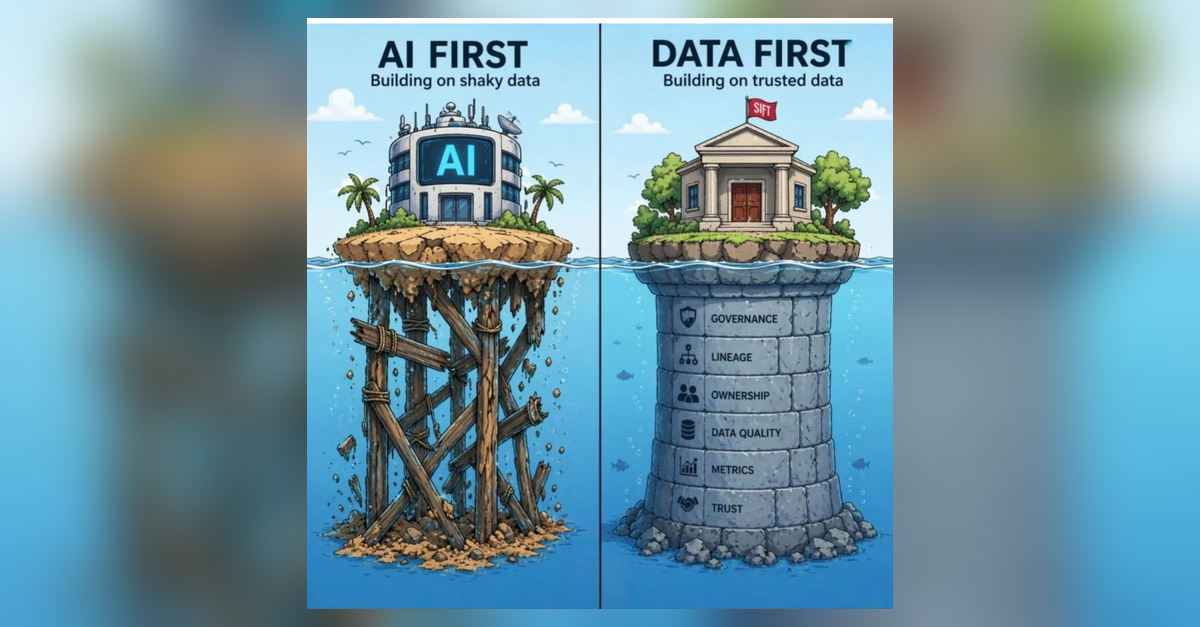
Why “AI-First” Without Data Foundations Is a Train Off a Bridge

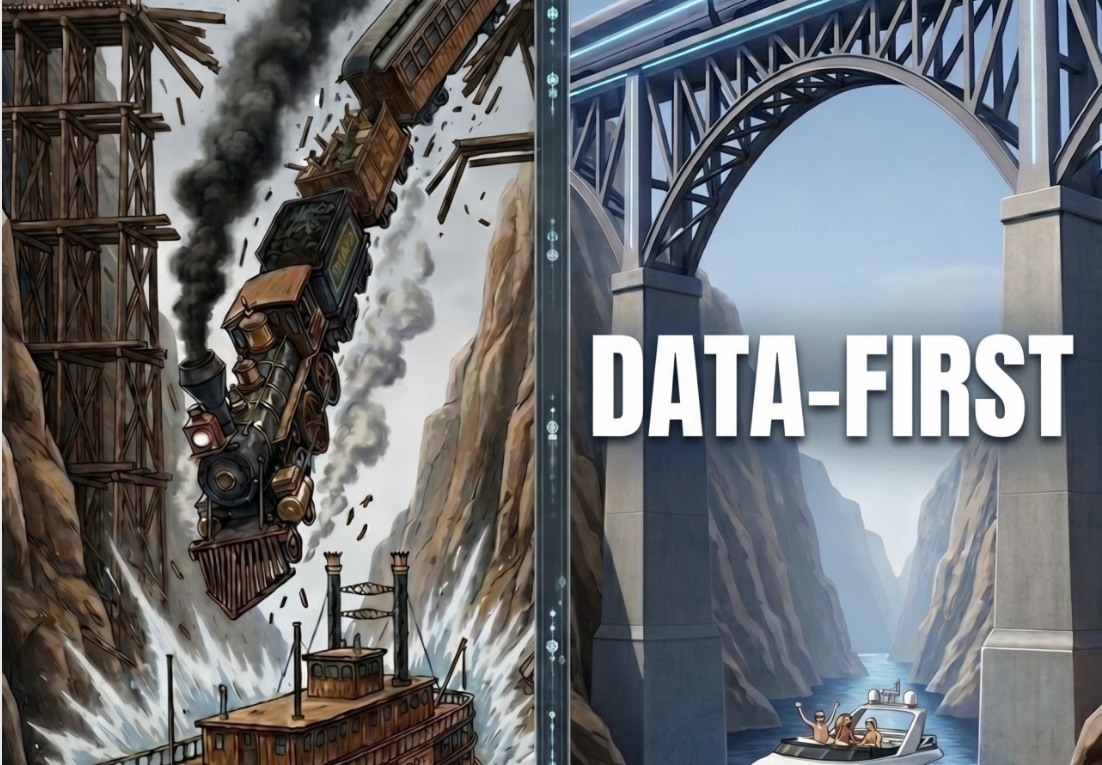
There’s a compelling image circulating in executive circles right now: on the left, a train derailing off an unfinished bridge — labeled “AI-First.” On the right, a sleek high-speed rail gliding across a completed arch over calm water — labeled “Data-First.”

It’s a meme. But it’s also one of the most accurate depictions of what I’ve witnessed in boardrooms and transformation programs across industries.


The AI-First Trap

When organizations declare themselves “AI-first,” the instinct is understandable. Generative AI, machine learning, and intelligent automation represent genuine competitive advantages. Boards are demanding it. CEOs are mandating it. The pressure to move fast is real.

But here’s what gets skipped in the rush: AI is only as intelligent as the data it learns from.

When you deploy AI on top of unstandardized, siloed, or ungoverned data, you don’t accelerate the business — you accelerate its mistakes. You automate bad decisions at scale. You surface hallucinated insights dressed up as analytics. You build expensive models on foundations that will shift beneath them.

I’ve seen this pattern repeatedly at the enterprise level. A major AI initiative launches with fanfare. Six months in, the models are underperforming. Eighteen months in, trust in AI outputs has eroded across the organization. The post-mortem almost always reveals the same root cause: the data wasn’t ready.


What “Data-First” Actually Means

Being data-first is not about slowing down AI adoption. It’s about building the infrastructure that makes AI sustainable, scalable, and trustworthy.

In practice, this means investing in:

Data Standardization & Harmonization Before any model trains on your data, that data needs to speak a common language across business units, systems, and geographies. Without this, your AI is reconciling contradictions, not learning patterns.

Canonical Data Models Every enterprise needs agreed-upon, authoritative definitions for its core entities — customers, products, transactions, events. Canonical models eliminate the ambiguity that corrupts AI outputs downstream. If your “customer” means seven different things across seven systems, your AI will reflect all seven conflicting realities at once.

Data Governance & Lineage AI explainability starts with data lineage. Regulators, auditors, and business leaders increasingly demand to know not just what the AI decided, but why — and that trail leads back to data. Governance frameworks aren’t bureaucratic overhead; they’re the foundation of AI accountability.

Master Data Management (MDM) MDM is unglamorous. It doesn’t make for exciting investor presentations. But it is the single most important enabler of enterprise AI at scale. Organizations that have invested in MDM consistently outperform those that haven’t when it comes to AI ROI.

Data Quality & Observability AI models don’t degrade randomly — they degrade because the data feeding them drifts, corrupts, or changes shape without anyone noticing. Data observability platforms and quality pipelines are now core infrastructure, not optional enhancements.


The CAIDO Perspective: Bridging Strategy and Execution

The role of a Chief AI and Data Officer — or Chief Data and AI Officer — exists precisely because these two disciplines cannot be separated. AI strategy without data strategy is theater. Data strategy without AI vision is missed opportunity.

Having led data and AI transformations at the executive level, the most consistent finding is this: the organizations that win with AI are the ones that treated data as a strategic asset before AI became a boardroom priority. They built the bridge before they needed to run trains across it.

The ones that struggle are chasing AI use cases while simultaneously trying to fix decade-old data quality problems in the background. It is extraordinarily difficult to do both at once — and expensive.


A Framework for Getting It Right

For executives navigating this, here is the sequence that consistently delivers results:

  1. Assess your data maturity honestly. Not aspirationally — honestly. Where are your critical data domains? How clean, consistent, and accessible are they?
  2. Define your canonical models before your AI roadmap. Every AI use case depends on core data entities. Define those entities first.
  3. Build a unified data platform. Cloud data lakehouses, semantic layers, and real-time data pipelines are the infrastructure layer that makes AI operationally viable.
  4. Align data governance with AI governance. These cannot be separate programs. AI risk management, bias detection, and model monitoring all trace back to data.
  5. Hire or develop for convergence. The talent that can hold both data engineering rigor and AI product thinking in the same mind is rare and extraordinarily valuable. Invest in finding it.

The Bottom Line

AI-first sounds bold. Data-first is bold — it’s just harder to put on a slide.

The companies that will lead their industries in five years are not necessarily the ones deploying the most AI today. They are the ones building the data infrastructure that will make their AI compounding and self-reinforcing rather than brittle and expensive to maintain.

Build the bridge. Then run the train.


I work at the intersection of enterprise data strategy, AI transformation, and organizational change — helping companies move from data chaos to AI-driven competitive advantage. If your organization is navigating this journey, I’d welcome the conversation.


#ChiefDataOfficer #ChiefAIOfficer #CDAO #CAIDO #DataStrategy #AIStrategy #DataGovernance #MasterDataManagement #EnterpriseAI #GenerativeAI #DigitalTransformation #DataTransformation #AITransformation #DataFirst #MLOps #DataManagement #ExecutiveLeadership #CDO #AILeadership #DataEngineering #BusinessIntelligence #DataQuality #AIReadiness #DataCulture #FutureOfWork

Learn more about Ramin Rastin’s enterprise data platform work on his Executive Profile.

The AI Revolution in Logistics Is No Longer Coming — It’s Already Here

Imagine a warehouse where autonomous robots move with precision, restocking shelves in real time, or a delivery route that dynamically adjusts to traffic and weather to ensure packages arrive ahead of schedule. These are not futuristic concepts. They are the current reality — powered by artificial intelligence and modern technology strategies.

As someone who has spent the last decade leading large-scale technology transformation as an SVP of Technology and Head of Data Engineering & Advanced Data Sciences, I’ve had a front-row seat to how AI is fundamentally reshaping the logistics and supply chain industry.

At its core, AI simulates human intelligence in machines — enabling them to learn, adapt, and make complex decisions. In logistics, this means combining machine learning, computer vision, robotics, predictive analytics, and real-time data orchestration to solve problems that once seemed unsolvable.

The results are already dramatic. Companies that have embraced enterprise technology strategy and AI leadership are seeing significant gains in operational efficiency, cost reduction, on-time delivery performance, and customer experience. From intelligent demand forecasting and automated inventory management to dynamic route optimization and predictive maintenance on fleets, AI is eliminating longstanding inefficiencies across the entire supply chain.

For CIOs, CTOs, and SVPs of Technology, the message is clear: the winners in this new era will be those who treat AI not as a bolt-on project, but as a core part of their technology vision and operating model. Organizations that successfully integrate AI into their logistics operations are moving faster, reducing waste, and building more resilient supply chains than their competitors.

The logistics industry is in the midst of one of the most significant technology transformations in decades — and the pace is only accelerating.

What are you seeing in your own operations? Are you actively leveraging AI to drive your supply chain strategy, or still in the early stages?

I’d love to hear your perspective in the comments.

Learn more about Ramin Rastin’s enterprise data platform work on his Executive Profile.

AI Is Not a Feature. It Is Infrastructure.

Across boardrooms today, the AI conversation is no longer about whether to invest — it is about how to operationalize at enterprise scale.

What separates organizations that experiment with AI from those that compete with it is not model accuracy. It is architecture.

In every large enterprise, AI ultimately exposes the same truth: your data, platform, and engineering discipline either enable scale — or prevent it.

The Shift from Innovation Theater to Enterprise Discipline

Most companies begin their AI journey with isolated use cases. A chatbot here. A forecasting model there. A pilot in marketing or operations.

But enterprise value does not come from pilots. It comes from institutional capability.

That capability rests on three pillars:

1. Architectural Cohesion

AI cannot sit on top of fragmented systems. It requires governed data models, standardized pipelines, streaming infrastructure, and clear ownership of platform strategy.

Without architectural cohesion, AI becomes an overlay. With it, AI becomes a multiplier.

2. Engineering Rigor

Deploying a model is easy. Operating hundreds of models globally, with observability, lineage, cost controls, and measurable business impact — that is engineering.

AI at scale requires:

  • Modern data platforms
  • MLOps discipline
  • CI/CD integration
  • Reliability engineering
  • Clear separation of experimentation and production

This is not a data science problem. It is a systems problem.

3. Financial Accountability

Technology leaders must connect AI initiatives directly to enterprise economics.

Operational efficiency. Revenue expansion. Margin improvement. Working capital optimization.

If AI is not tied to measurable financial outcomes, it becomes overhead. When it is aligned with EBITDA and strategic growth, it becomes infrastructure.

The Evolving Role of the CIO and CTO

The modern CIO or CTO is no longer a steward of systems alone. The role has evolved into three simultaneous mandates:

  • Architecting enterprise-scale platforms
  • Embedding AI into core business workflows
  • Ensuring technology investment translates into financial performance

This requires fluency across architecture, data engineering, AI deployment patterns, vendor ecosystems, and enterprise operating models.

It also requires the discipline to say no. Not every problem requires AI. Not every AI use case warrants scale. The strongest leaders focus on repeatable enterprise capabilities rather than isolated wins.

Enterprise Architecture as Competitive Advantage

In the AI era, architecture becomes a moat.

Organizations that unify their data ecosystems, modernize their cloud platforms, and institutionalize AI engineering discipline move faster, operate leaner, and compete more effectively.

Those that treat AI as an application layer struggle with scale, governance, and cost.

The difference is not talent. It is structure.

The Future Belongs to Operational AI

The next wave of value creation will not come from experimentation. It will come from embedding AI into:

  • Supply chains
  • Underwriting engines
  • Dynamic pricing
  • Workforce optimization
  • Customer engagement systems

AI will not sit beside operations. It will become part of them.

That transformation requires leadership willing to define strategy, modernize platforms, strengthen engineering culture, and align technology with enterprise economics.

AI is not a feature. It is not a department. It is not a pilot.

It is infrastructure.

And infrastructure, when designed correctly, becomes the foundation for long-term competitive advantage.

#CIO #CTO #AILeadership #EnterpriseArchitecture #DigitalTransformation #DataStrategy #TechnologyLeadership #MachineLearning

Learn more about Ramin Rastin’s enterprise data platform work on his Executive Profile.

The Operating System Behind Modern Enterprises

There is a misconception in today’s market that digital transformation is about adopting new tools.

It is not.

It is about redesigning the operating system of the enterprise.

Across industries — logistics, healthcare, financial services, industrial, SaaS — organizations are investing billions into cloud, AI, and analytics. Yet many still struggle to convert those investments into durable operational advantage.

The difference is not the model. It is the architecture.

From Fragmented Systems to Enterprise Platforms

Modern enterprises generate massive volumes of transactional data across distributed operations. Warehouses, financial systems, customer platforms, applications, APIs, and machine-generated telemetry all produce continuous streams of information.

The organizations that win treat this data as infrastructure — not exhaust.

A scalable architecture today requires:

  • Event-driven ingestion capable of handling millions of daily transactions
  • Unified streaming and batch processing
  • A governed lakehouse foundation
  • Globally consistent transactional systems
  • Embedded analytics and production AI
  • Strict security, lineage, and access controls

Without this foundation, AI initiatives remain pilot projects.

With it, intelligence becomes embedded directly into operations.

The Lakehouse as Enterprise Backbone

The lakehouse model has matured into the most pragmatic pattern for large-scale enterprises.

Object storage provides elasticity and cost efficiency.

Cloud-native compute platforms provide governed, high-performance analytics.

Streaming frameworks allow real-time operational visibility.

When designed correctly, this architecture supports:

  • 24/7 global operations
  • High transaction throughput
  • Multi-region availability
  • Secure client segregation
  • Self-service analytics at scale
  • AI and ML workloads without re-architecting

This is not theoretical. It is operational reality.

AI: Beyond the Model

There is significant attention on foundation models and generative AI. These technologies are powerful, but they do not create value in isolation.

Enterprise AI requires:

  • Clean, curated, and governed data
  • Controlled inference environments
  • Observability and cost discipline
  • Clear human oversight thresholds
  • Integration into existing workflows

Retrieval-augmented patterns, feature engineering pipelines, and production-grade MLOps are more important than novelty.

AI becomes transformative only when it improves EBITDA, margin, risk posture, or growth velocity.

Otherwise, it is overhead.

The CTO/CIO Mandate Has Changed

The modern technology executive must be agile. You must understand distributed systems and board-level capital allocation in the same conversation. You must know when to modernize and when to stabilize. You must balance innovation with operational reliability. Technology today is no longer a support function. It is a strategic lever. The organizations that recognize this build platforms, not projects. They architect for resilience, scalability, and intelligence from day one. And they understand that digital leadership is not about adopting tools. It is about building the foundation that allows the enterprise to move faster than its competitors.

The question is no longer whether to invest in AI or cloud. The real question is: Is your architecture capable of supporting the future you are promising the market?

#CIO #CTO #AILeadership #EnterpriseArchitecture #DigitalTransformation

Learn more about Ramin Rastin’s enterprise data platform work on his Executive Profile.

What It Really Takes to Scale AI and Advanced Data Science at the Enterprise Level

As organizations accelerate their adoption of AI, many quickly discover that experimentation is easy — scaling AI responsibly, reliably, and profitably is not.

As an SVP of Advanced Data Science and AI, leading global teams across complex, operational environments, I’ve seen firsthand that enterprise AI success is rarely about models alone. It’s about building the foundations that allow AI to move from isolated use cases into day-to-day decision-making at scale.

AI at Scale Starts with Data Engineering Discipline

Advanced analytics, machine learning, and generative AI are only as effective as the data platforms beneath them. At enterprise scale, AI depends on:

  • Unified, governed data foundations
  • Consistent definitions across regions and business units
  • Reliable pipelines that support both real-time and batch use cases

Without this, even the most sophisticated models struggle to deliver sustained value.

Moving from Insight to Action

The real shift happens when organizations move beyond descriptive and predictive analytics into operational and autonomous decision-making. This is where advanced data science teams create impact:

  • Embedding AI directly into workflows
  • Enabling forecasting, optimization, and scenario modeling at operational speed
  • Supporting leaders with trusted, explainable outputs they can act on with confidence

In logistics and supply chain environments — and increasingly across industries — this shift drives measurable gains in efficiency, service levels, and margin.

The Enterprise Reality of AI Leadership

Scaling AI isn’t just a technical challenge. It’s an organizational one.

Successful AI leaders must balance:

  • Innovation with governance
  • Speed with security and compliance
  • Local execution with global consistency

This requires close partnership across operations, product, engineering, finance, and executive leadership — and a clear understanding of where AI creates business value versus noise.

What Differentiates High-Impact AI Organizations

The organizations that succeed with AI at scale tend to share a few traits:

  • They treat AI as a business capability, not a side project
  • They invest equally in people, platforms, and operating models
  • They measure success in outcomes — cost reduction, revenue enablement, resilience, and customer experience

Advanced data science teams become force multipliers when they are deeply connected to how the business actually runs.

Looking Ahead

AI is rapidly becoming a core enterprise competency. The next phase of competitive advantage will belong to organizations that can industrialize AI — safely, transparently, and at scale — while continuously adapting as technologies evolve.

For senior leaders, the challenge isn’t whether to adopt AI, but how to make it real across the enterprise.

Advanced Data Science and AI in Logistics: Why the Next Decade Will Be Won in Operations, Not Experiments

Over the past few years, advanced data science and AI have moved from novelty to necessity across the supply chain. Most large logistics organizations today are running pilots in forecasting, optimization, automation, and generative AI. Far fewer are successfully operationalizing these capabilities at enterprise scale.

The difference is no longer access to algorithms. It is the ability to turn advanced data science into durable, production-grade systems that operate reliably in real-world logistics environments.

Logistics Is Where AI Gets Tested for Real

Supply chains are one of the most demanding environments for AI. They are physical, distributed, time-sensitive, and cost-constrained. Data arrives from dozens of systems—WMS, TMS, OMS, ERP, automation, robotics, sensors, and customer platforms—often with inconsistent definitions and latency.

Advanced data science in this context must handle:

  • High-volume, noisy time-series data
  • Rapid shifts in demand, inventory, and labor
  • Tight service-level commitments
  • Margin pressure and operational constraints

AI that works in a lab but fails under operational variability does not create value. Logistics forces discipline.

From Predictive Analytics to Autonomous Decision-Making

Many organizations have matured their descriptive and predictive analytics capabilities. The real inflection point is moving from prediction to action.

Advanced data science is now being applied to:

  • Dynamic labor and capacity planning
  • Network-wide demand and inventory positioning
  • Real-time exception management
  • Customer-specific service and cost optimization

This shift requires more than better models. It requires tight integration between data engineering, AI systems, and operational workflows so decisions can be executed, monitored, and continuously improved.

Data Engineering Is the Unsung Differentiator

In logistics, advanced data science succeeds or fails based on data foundations.

Strong outcomes depend on:

  • Unified, governed data platforms across regions and customers
  • Scalable batch and real-time pipelines
  • Clear semantic models and master data
  • Architecture designed for low-latency operational decisioning

When these foundations are weak, every new AI use case becomes bespoke and fragile. When they are strong, AI becomes repeatable, scalable, and economically meaningful.

Generative AI Has Accelerated Expectations

Generative AI has raised expectations across logistics organizations, from frontline operations to executive teams. The most successful deployments are not replacing core optimization models; they are augmenting them.

In practice, GenAI is creating value by:

  • Enabling faster insight and decision support for operators
  • Improving customer-facing analytics and explanations
  • Accelerating solution design and scenario analysis
  • Reducing friction in complex operational workflows

As with all AI, governance and integration matter more than novelty.

Governance and Scale Are Not Tradeoffs

In global logistics environments, governance is often viewed as friction. In reality, governance is what enables scale.

Clear ownership, standardized platforms, and responsible AI practices allow advanced data science solutions to be deployed consistently across sites, regions, and customers without rework or risk. The organizations that move fastest are the ones that build governance into the platform rather than layering it on afterward.

The Role of Advanced Data Science Leadership

The future of logistics will be shaped by leaders who understand both sides of the equation:

  • The technical depth required to build advanced AI systems
  • The operational reality of running those systems in production

Advanced data science leadership today is less about experimentation and more about execution—turning AI into a reliable operating capability that improves efficiency, resilience, and customer outcomes at scale.

The next decade in logistics will not be won by the companies with the most AI initiatives, but by those that can consistently deploy advanced data science where it matters most: in day-to-day operations.

AI in the Supply Chain: Why Data Foundations Decide Who Scales and Who Stalls

AI has become a common topic in supply chain discussions, from demand forecasting and labor optimization to automation and real-time decisioning. Most large organizations are experimenting. Far fewer are consistently deploying AI across sites, regions, and customer environments with repeatable results.

In practice, the difference is rarely the sophistication of the algorithms. It is the strength of the data foundation underneath them.

Supply Chains Are AI’s Hardest Environment

Supply chains are uniquely difficult environments for AI. They are distributed, highly variable, and deeply operational. Data arrives from many systems—WMS, TMS, OMS, ERP, robotics, sensors, and customer platforms—often with inconsistent definitions and latency.

AI in this context must operate across:

  • High-volume, time-series data
  • Rapidly changing demand and inventory profiles
  • Labor variability and physical constraints
  • Tight cost and service-level expectations

Without strong data engineering and platform discipline, AI models quickly degrade or fail to generalize beyond isolated pilots.

Why Data Engineering Matters More Than Ever

Successful AI-driven supply chains start with data engineering, not models.

That means building:

  • Unified, governed data platforms that normalize signals across systems
  • Scalable ingestion and transformation pipelines that support both real-time and batch use cases
  • Clear semantic models and master data that align operations, finance, and customers
  • Architectures designed for low-latency decisioning at site and network levels

When these foundations are in place, AI becomes repeatable. When they are not, every new use case becomes a custom rebuild.

Moving from Forecasting to Autonomous Decisions

Many organizations have reached maturity in descriptive and predictive analytics. The next inflection point is autonomous decision-making—systems that don’t just forecast outcomes but recommend or execute actions.

In supply chain environments, this includes:

  • Dynamic labor and capacity alignment
  • Inventory positioning and flow optimization
  • Exception-based orchestration across sites
  • Customer-specific service and cost tradeoffs

Reaching this level requires tight integration between data engineering, AI models, and operational workflows. AI that lives outside the execution layer rarely delivers sustained value.

Governance Is a Competitive Advantage

Speed and governance are often framed as tradeoffs. In supply chain AI, they are inseparable.

Clear data ownership, standardized platforms, and responsible AI practices allow organizations to deploy solutions globally without increasing risk. Governance enables reuse, accelerates rollout across regions, and ensures AI behaves predictably under operational stress.

The most effective supply chain AI programs treat governance as part of the platform—not as an afterthought.

The Leaders Who Succeed Think End-to-End

The supply chains that extract real value from AI are led by teams that own the full lifecycle:

  • Data engineering and platforms
  • AI and analytics
  • MLOps and reliability
  • Integration into operations and customer workflows

When these responsibilities are aligned, AI becomes an operational capability rather than a series of experiments.

The future of supply chain competitiveness will be defined not by who has the most AI initiatives, but by who has the discipline to run AI reliably at enterprise scale.

Making AI Real at Enterprise Scale: Why Data Engineering Still Matters More Than Models

Generative AI has moved quickly from research labs into boardroom agendas. Nearly every enterprise is experimenting with AI. Far fewer are running it reliably at scale, in production, with measurable business impact.

In practice, the gap is rarely about models. It is almost always about foundations.

Enterprise AI only works when it is built on strong data engineering, disciplined platforms, and clear operating models. Without reliable pipelines, governed data, and scalable infrastructure, even the most advanced AI remains fragile, expensive, or stuck in pilot mode.

Data Engineering Is the Difference Between Demos and Durability

Many organizations treat data engineering as something to complete before “real AI” begins. In reality, data engineering is the long-term differentiator.

Production AI depends on consistent data across domains, scalable ingestion and transformation pipelines, architectures that support both real-time and batch decisioning, and clear ownership, lineage, and governance. When these foundations are weak, AI stalls. When they are strong, AI becomes repeatable and economically viable.

From Experimentation to Production AI

Moving from experimentation to production requires a different mindset. At enterprise scale, AI must be designed for reliability, observability, security, and cost from day one.

That includes end-to-end MLOps, model monitoring tied to business outcomes, embedded privacy and regulatory controls, and operating models that support continuous improvement. This is where data engineering, AI engineering, and platform engineering converge. Treating them as separate disciplines slows progress and increases risk.

Governance Accelerates, Not Slows, Innovation

A common misconception is that governance slows innovation. In practice, the absence of governance is what slows enterprises down.

Clear data ownership, standardized platforms, and responsible AI frameworks allow teams to move faster with confidence. Governance done well reduces rework, eliminates ambiguity, and enables AI solutions to scale across regions and business units without being rebuilt each time.

AI That Matters Is AI That Ships

The most effective AI programs are not the ones with the most experiments. They are the ones that consistently deliver AI into core operations, customer experiences, and decision-making processes.

That requires leadership that understands both the data engineering foundations that make AI possible and the AI capabilities that turn data into action. When those responsibilities are aligned, AI stops being a promise and becomes a durable enterprise capability.