
Why “AI-First” Without Data Foundations Is a Train Off a Bridge
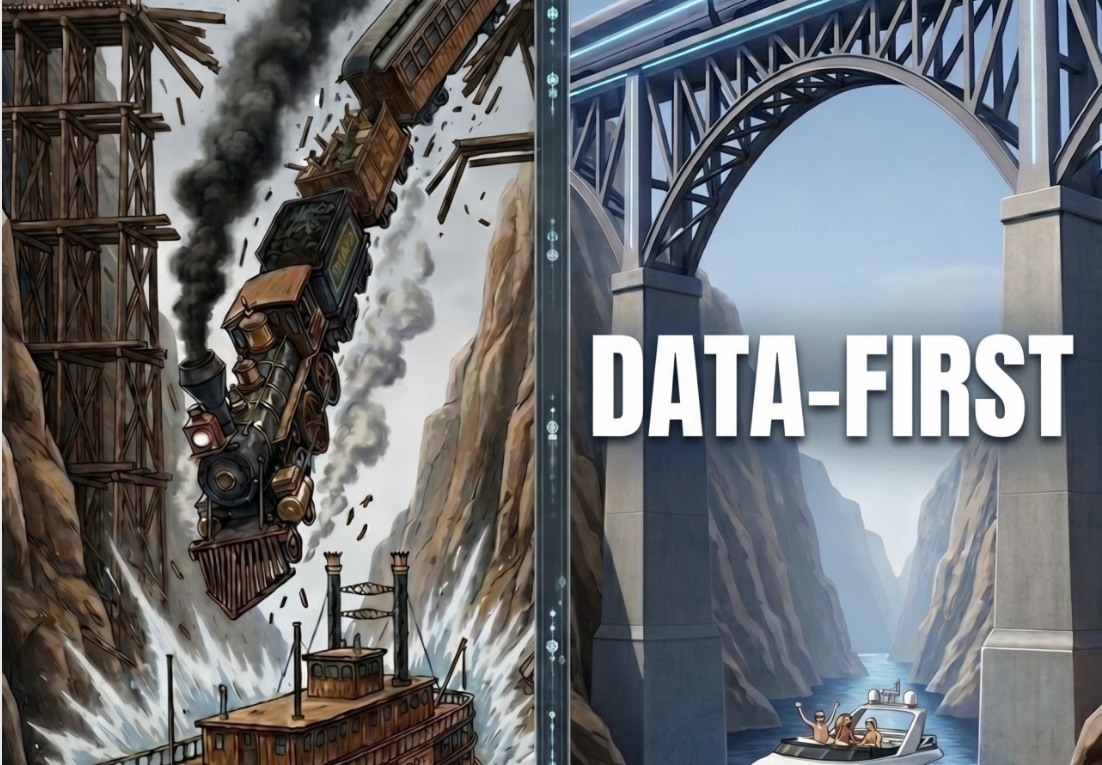
There’s a compelling image circulating in executive circles right now: on the left, a train derailing off an unfinished bridge — labeled “AI-First.” On the right, a sleek high-speed rail gliding across a completed arch over calm water — labeled “Data-First.”
It’s a meme. But it’s also one of the most accurate depictions of what I’ve witnessed in boardrooms and transformation programs across industries.
The AI-First Trap
When organizations declare themselves “AI-first,” the instinct is understandable. Generative AI, machine learning, and intelligent automation represent genuine competitive advantages. Boards are demanding it. CEOs are mandating it. The pressure to move fast is real.
But here’s what gets skipped in the rush: AI is only as intelligent as the data it learns from.
When you deploy AI on top of unstandardized, siloed, or ungoverned data, you don’t accelerate the business — you accelerate its mistakes. You automate bad decisions at scale. You surface hallucinated insights dressed up as analytics. You build expensive models on foundations that will shift beneath them.
I’ve seen this pattern repeatedly at the enterprise level. A major AI initiative launches with fanfare. Six months in, the models are underperforming. Eighteen months in, trust in AI outputs has eroded across the organization. The post-mortem almost always reveals the same root cause: the data wasn’t ready.
What “Data-First” Actually Means
Being data-first is not about slowing down AI adoption. It’s about building the infrastructure that makes AI sustainable, scalable, and trustworthy.
In practice, this means investing in:
Data Standardization & Harmonization Before any model trains on your data, that data needs to speak a common language across business units, systems, and geographies. Without this, your AI is reconciling contradictions, not learning patterns.
Canonical Data Models Every enterprise needs agreed-upon, authoritative definitions for its core entities — customers, products, transactions, events. Canonical models eliminate the ambiguity that corrupts AI outputs downstream. If your “customer” means seven different things across seven systems, your AI will reflect all seven conflicting realities at once.
Data Governance & Lineage AI explainability starts with data lineage. Regulators, auditors, and business leaders increasingly demand to know not just what the AI decided, but why — and that trail leads back to data. Governance frameworks aren’t bureaucratic overhead; they’re the foundation of AI accountability.
Master Data Management (MDM) MDM is unglamorous. It doesn’t make for exciting investor presentations. But it is the single most important enabler of enterprise AI at scale. Organizations that have invested in MDM consistently outperform those that haven’t when it comes to AI ROI.
Data Quality & Observability AI models don’t degrade randomly — they degrade because the data feeding them drifts, corrupts, or changes shape without anyone noticing. Data observability platforms and quality pipelines are now core infrastructure, not optional enhancements.
The CAIDO Perspective: Bridging Strategy and Execution
The role of a Chief AI and Data Officer — or Chief Data and AI Officer — exists precisely because these two disciplines cannot be separated. AI strategy without data strategy is theater. Data strategy without AI vision is missed opportunity.
Having led data and AI transformations at the executive level, the most consistent finding is this: the organizations that win with AI are the ones that treated data as a strategic asset before AI became a boardroom priority. They built the bridge before they needed to run trains across it.
The ones that struggle are chasing AI use cases while simultaneously trying to fix decade-old data quality problems in the background. It is extraordinarily difficult to do both at once — and expensive.
A Framework for Getting It Right
For executives navigating this, here is the sequence that consistently delivers results:
- Assess your data maturity honestly. Not aspirationally — honestly. Where are your critical data domains? How clean, consistent, and accessible are they?
- Define your canonical models before your AI roadmap. Every AI use case depends on core data entities. Define those entities first.
- Build a unified data platform. Cloud data lakehouses, semantic layers, and real-time data pipelines are the infrastructure layer that makes AI operationally viable.
- Align data governance with AI governance. These cannot be separate programs. AI risk management, bias detection, and model monitoring all trace back to data.
- Hire or develop for convergence. The talent that can hold both data engineering rigor and AI product thinking in the same mind is rare and extraordinarily valuable. Invest in finding it.
The Bottom Line
AI-first sounds bold. Data-first is bold — it’s just harder to put on a slide.
The companies that will lead their industries in five years are not necessarily the ones deploying the most AI today. They are the ones building the data infrastructure that will make their AI compounding and self-reinforcing rather than brittle and expensive to maintain.
Build the bridge. Then run the train.
I work at the intersection of enterprise data strategy, AI transformation, and organizational change — helping companies move from data chaos to AI-driven competitive advantage. If your organization is navigating this journey, I’d welcome the conversation.
#ChiefDataOfficer #ChiefAIOfficer #CDAO #CAIDO #DataStrategy #AIStrategy #DataGovernance #MasterDataManagement #EnterpriseAI #GenerativeAI #DigitalTransformation #DataTransformation #AITransformation #DataFirst #MLOps #DataManagement #ExecutiveLeadership #CDO #AILeadership #DataEngineering #BusinessIntelligence #DataQuality #AIReadiness #DataCulture #FutureOfWork
Learn more about Ramin Rastin’s enterprise data platform work on his Executive Profile.